Program-analysis-guided PoC generation for FFmpeg
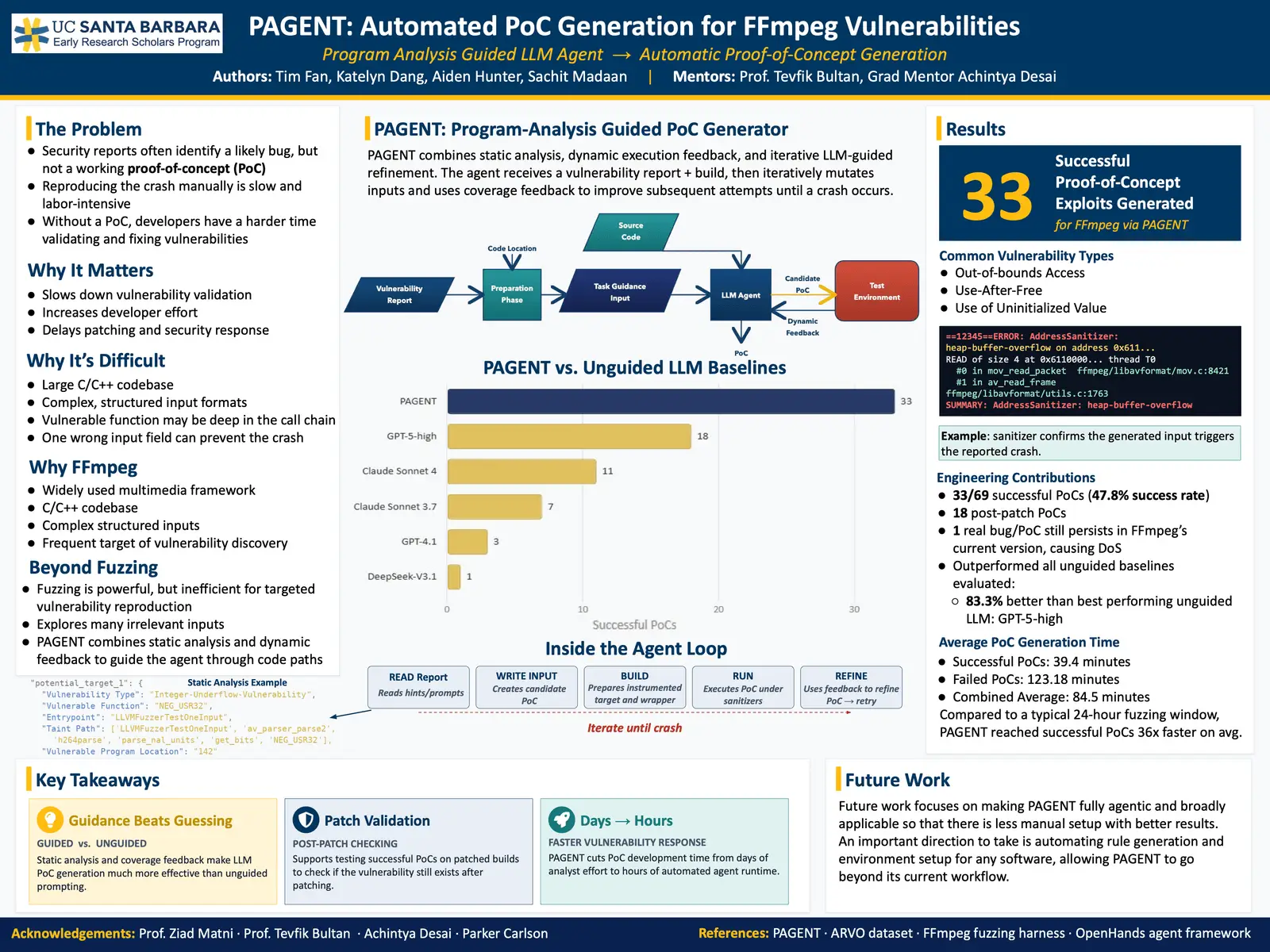
A vulnerability report usually tells you a bug exists. It rarely gives you a file that triggers it. Somebody still has to sit down with the report, the source, and a debugger, and build an input that makes the crash happen. That takes days, and until it is done nobody can confirm the bug is real or check that a patch actually fixed it.
PAGENT automates that step. My ERSP team at the UCSB Verification Lab spent the year taking it and making it work against FFmpeg, which is where almost all of our time went.
Why FFmpeg is the hard case
FFmpeg parses deeply structured binary formats, and the function that crashes is usually several layers down a call chain that begins at a container parser. To reach it you need a file whose headers, indices, and offsets are all internally consistent. One wrong field and the parser rejects the input long before it touches the vulnerable code.
That is also why fuzzing is a poor fit for this specific job. Fuzzing is good at finding bugs you did not know about. Here we already knew the bug and the line it lived on, and we wanted one input that reached it. A fuzzer spends most of a 24 hour window on inputs that die in the first few hundred bytes.
What the loop actually does
The agent reads the vulnerability report, writes a candidate input, builds an instrumented target, runs it under AddressSanitizer, and reads what comes back. No crash means it looks at coverage to see how far the input got before it was rejected, then revises and tries again.
Static analysis is what keeps that loop from being a guessing game. Before the agent starts it gets a vulnerability type, the vulnerable function, an entrypoint, a taint path through the call chain, and a line number. So the agent knows what it is aiming at, and coverage tells it how close it landed.
Most of what we found were out of bounds accesses, use after free, and uses of uninitialized memory.
Numbers
We ran it against 69 known FFmpeg vulnerabilities and got working PoCs for 33 of them, a 47.8% success rate.
For comparison we ran the same reports through unguided LLM prompting. The best of those was GPT-5-high at 18. Claude Sonnet 4 got 11, Claude Sonnet 3.7 got 7, GPT-4.1 got 3, DeepSeek-V3.1 got 1. Guided beat the strongest unguided baseline by 83%.
Timing was lopsided in a useful way. A successful run averaged 39.4 minutes. A failed one averaged 123.18 minutes, because failure means burning the full iteration budget before giving up. Combined that is 84.5 minutes per report. Against a 24 hour fuzzing window, the runs that worked got there roughly 36 times faster.
The one that still works
We also took successful PoCs and replayed them against patched builds, which is the check that tells you whether a fix actually closed the hole. We ran 18 of them that way.
One still reproduces on current FFmpeg and causes a denial of service. That result is the part I keep coming back to, because it came out of a pipeline whose whole purpose was to reproduce bugs that were already supposed to be fixed.
What I would tell the next team
The agent was never the bottleneck. Getting FFmpeg to build reproducibly with sanitizers, wiring up the fuzzing harness, and making the environment consistent enough that a failed run meant something took far longer than any prompting work. When a run failed early on, the honest answer was usually that our setup was wrong, not that the model was.
That is also the clearest direction for future work. Right now pointing PAGENT at a new project means a lot of manual environment and rule setup. Automating that is what would make it general.
Work with Tim Fan, Katelyn Dang, and Aiden Hunter, mentored by Prof. Tevfik Bultan and Achintya Desai, in the UCSB Verification Lab.
All writing